

描述
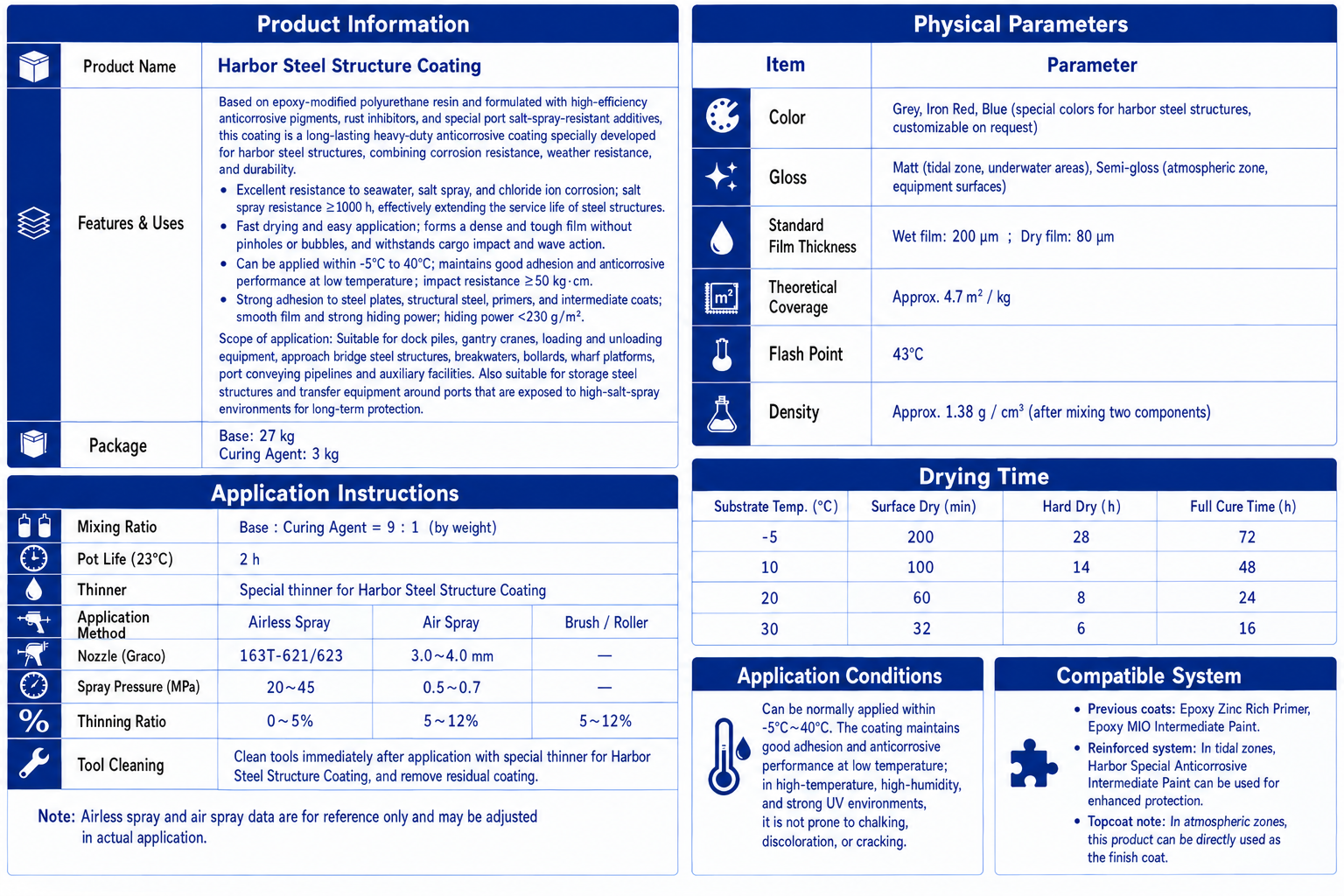
Physical Parameters
Color: Grey, iron red, blue (specialized seawater corrosion-resistant colors, customizable upon request to facilitate underwater inspection and identification)
Gloss: Matt / Flat (for tidal zones and underwater sections), Semi-gloss (for atmospheric zones and equipment surfaces)
Standard Film Thickness:
Wet Film Thickness (WFT): 200 μm
Dry Film Thickness (DFT): 80 μm
Theoretical Spreading Rate: Approx. 4.7 ㎡/kg
Flash Point: 43°C
Density: Approx. 1.38 g/cm³ (after mixing the two components)
Application Instructions
Mixing Ratio: Base : Curing Agent = 9 : 1 (by weight)
Pot Life (23°C): 2 hours
Thinner: Port Steel Structure Anti-Corrosive Paint Dedicated Thinner (Note: The use of general thinners is strictly prohibited as it will degrade the film’s anti-corrosive properties and weatherability. If the paint is too thick during application, adjust the viscosity exclusively using the dedicated thinner.)
Cleaning Solvent: Port Steel Structure Anti-Corrosive Paint Dedicated Thinner. Clean all tools immediately after use to completely remove residual paint, preventing cleanup difficulties and tool blockages caused by product curing. For waterborne variants of this type, application tools can be cleaned with water to ensure pollution-free construction.
Application Methods: Airless Spray, Conventional Air Spray, or Brush/Roller Coating.
Spraying Parameters
| Parameter | Airless Spray | Conventional Air Spray | Brush / Roller |
| Nozzle/Tip Size | (Graco) 163T-621/623 | 3.0 ~ 4.0 mm | — |
| Fluid Pressure (MPa) | 20 ~ 45 | 0.5 ~ 0.7 | — |
| Thinning Ratio | 0 ~ 5% | 5 ~ 12% | 5 ~ 12% |
Note: Airless and conventional air spray data are for reference only and can be adjusted based on onsite conditions during practical application.
Drying Time & Full Curing Time
| Substrate Temp. (°C) | Surface Dry (min) | Hard Dry (h) | Full Curing Time (h) |
| -5 | 200 | 28 | 72 |
| 10 | 100 | 14 | 48 |
| 20 | 60 | 8 | 24 |
| 30 | 32 | 6 | 16 |
Surface Preparation
Steel Substrates: The surface of the substrate or intermediate coat must be clean, dry, and completely free of oil stains, corrosion, old paint residue, cargo dust, and marine growth. Surface cleanliness should reach Sa2.5 grade (abrasive blasting) or St3 grade (manual/power-tool cleaning) to ensure the complete removal of mill scale, rust, and oil.
Concrete Substrates: Concrete base surfaces must be abraded to remove laitance and expose a solid substrate. The moisture content must be $\le$ 8%, otherwise the coating is highly susceptible to blistering and flaking.
General Requirements: Wash the surface thoroughly with high-pressure fresh water to remove salts, dirt, and dust, as residual salt or dust will compromise corrosion resistance. Allow the surface to dry completely (moisture content $\le$ 6%) before coating.
Overcoating: When overcoating existing port anti-corrosive paint or epoxy coatings, the old film must be abraded and roughened to eliminate chalked, loose, or peeling areas, ensuring excellent intercoat adhesion and preventing delamination. Tightly adhered old coatings do not need to be removed during maintenance.
Application Conditions
Temperature & Humidity: The application temperature range is -5 ~ 40°C with a relative humidity (RH) below 85%. The substrate surface temperature must be at least 3°C above the dew point. All measurements of temperature and humidity must be taken close to the substrate in the port application area.
Constraints: High-altitude spray application is not recommended if the wind speed exceeds Force 5 ($> 8.0 \sim 10.7\,\text{m/s}$). Tidal zone applications must avoid high tide periods.
High-Temperature Constraints: Coating operations are not recommended if the substrate surface temperature exceeds 50°C, avoiding film defects like pinholes, wrinkling, or incomplete curing.
Adverse Weather: Outdoor application is strictly prohibited during rain, snow, heavy winds, sandstorms, dense fog, or high humidity conditions. Stop application on rainy days or when the relative humidity exceeds 85% to safeguard coating quality.
Sub-Zero Operations: For applications below 0°C, the substrate surface must be entirely free of ice, snow, or frost, and anti-freezing measures must be taken to guarantee normal film formation.
Coating System Compatibility
Preceding Coats: Zinc-Rich Epoxy Primer or Epoxy MIO Intermediate Paint.
System Recommendation: For tidal zones, pairing with a specialized port anti-corrosive intermediate paint is recommended to enhance protection. The zinc-rich epoxy primer leverages cathodic protection to significantly boost rust prevention. When used as a complete multi-layer system (primer, intermediate, topcoat), the anti-corrosion effect is optimized. For atmospheric zones, this product can be directly matched as the topcoat to form a complete, long-term anti-corrosive system for port steel structures.
Packaging Specifications
Base (Part A): 27 kg
Curing Agent (Part B): 3 kg
Storage
Store this product in a cool, dry, and well-ventilated indoor warehouse, away from open flames and heat sources. Avoid direct sunlight.
Do not store together with acidic, alkaline, or oxidizing substances. The shelf life is 12 months under normal room temperature (5-30°C) conditions. After expiration, the product can still be used if it passes inspection for all technical specifications.
The base, curing agent, and any additives (such as mica powder) must be stored separately. Once opened, the product should be used as soon as possible; any unused portion must be tightly sealed to prevent moisture absorption, curing, or contamination.
Safety Precautions
All sources of ignition and smoking are strictly prohibited at the mixing and application sites. Maintain excellent ventilation to reduce paint mist concentration and avoid the inhalation of harmful components (especially during high-altitude operations where ventilation protection must be reinforced).
Applicators must wear appropriate personal protective equipment (PPE), including protective masks, safety goggles, solvent-resistant gloves, and anti-slip shoes. Safety harnesses are mandatory for high-altitude operations to prevent falls, paint mist inhalation, or eye and skin contact.
If paint contacts the skin, wash immediately with soap and water or a specialized skin cleanser. If it splashes into the eyes, rinse continuously with plenty of water for at least 15 minutes and seek immediate medical attention.
Warning signs must be placed around the application area to restrict unauthorized entry. Clean up and collect residual coatings and thinners promptly after construction for centralized disposal to avoid polluting the marine and surrounding environments.
Disclaimer
The protective performance of any coating largely depends on application factors. Surface preparation and film thickness will directly affect the service life of the coating. Users must ensure compliance with the specified application conditions.
The data provided in this manual are theoretical values or derived from experimental accumulation. Some data may change due to continuous product improvements without prior notice.
When our company’s technical personnel are not present at the application site, the company is solely liable for the quality of the coating product itself.