

描述
Physical Parameters
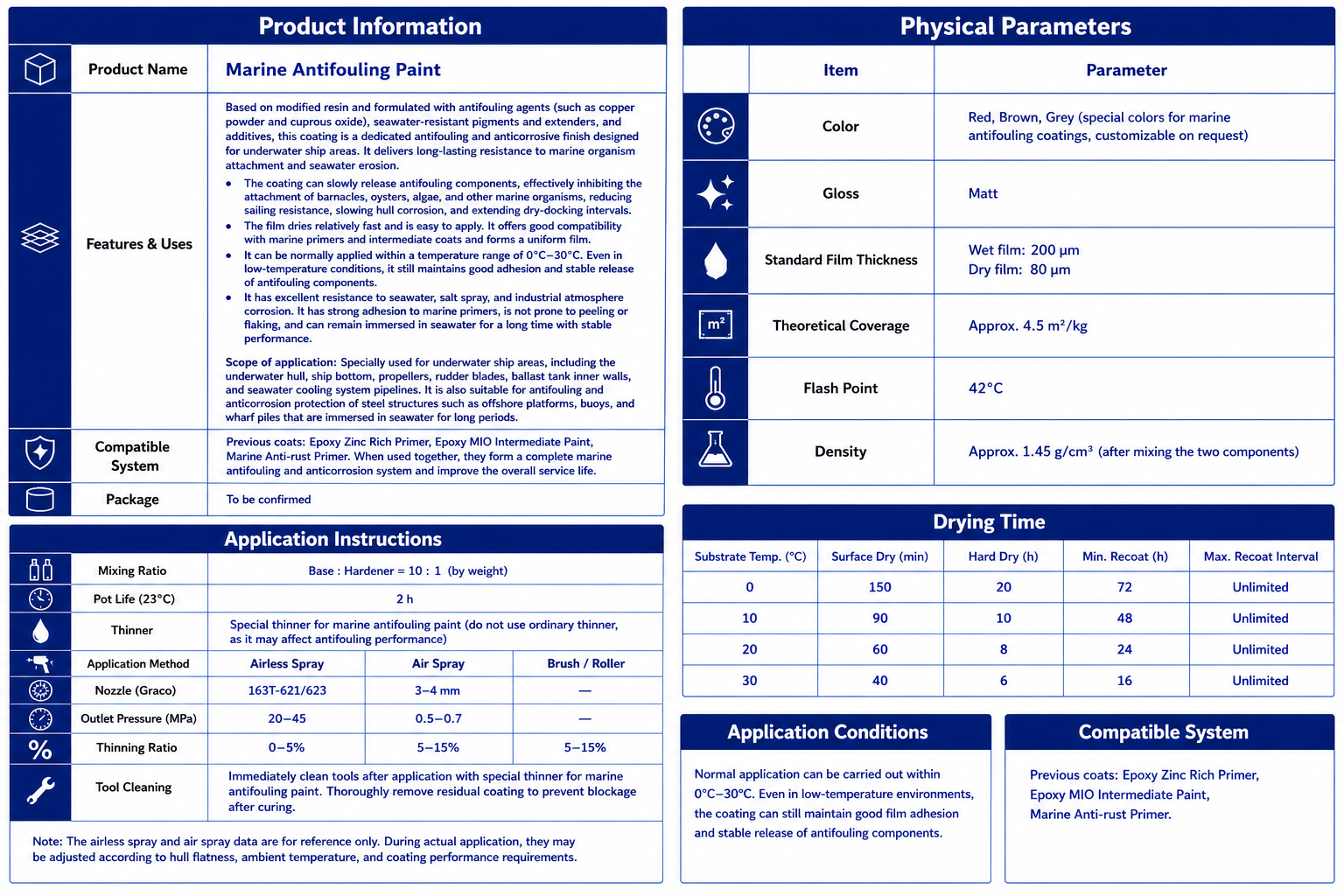
Color: Red, brown, grey (specialized marine antifouling colors, customizable upon request)
Gloss: Matt / Flat
Standard Film Thickness:
Wet Film Thickness (WFT): 200 μm
Dry Film Thickness (DFT): 80 μm
Theoretical Spreading Rate: Approx. 4.5 ㎡/kg
Flash Point: 42°C
Density: Approx. 1.45 g/cm³ (after mixing the two components)
Application Instructions
Mixing Ratio: Base : Curing Agent = 10 : 1 (by weight)
Pot Life (23°C): 2 hours
Thinner: Marine Antifouling Paint Dedicated Thinner (Note: The use of general thinners is strictly prohibited as it will compromise antifouling performance.)
Cleaning Solvent: Marine Antifouling Paint Dedicated Thinner. Clean all tools immediately after use to remove any residual coating and prevent blockages caused by paint curing.
Application Methods: Airless Spray, Conventional Air Spray, or Brush/Roller Coating. (Airless spraying is highly preferred for large-area applications on the ship bottom.)
Spraying Parameters
| Parameter | Airless Spray | Conventional Air Spray | Brush / Roller |
| Nozzle/Tip Size | (Graco) 163T-621/623 | 3 ~ 4 mm | — |
| Fluid Pressure (MPa) | 20 ~ 45 | 0.5 ~ 0.7 | — |
| Thinning Ratio | 0 ~ 5% | 5 ~ 15% | 5 ~ 15% |
Note: Airless and conventional air spray data are for reference only. Practical adjustments can be made based on hull smoothness, ambient temperature, and application performance.
Drying Time & Overcoating Interval
| Substrate Temp. (°C) | Surface Dry (min) | Hard Dry (h) | Min. Overcoating Interval (h) | Max. Overcoating Interval |
| 0 | 150 | 20 | 72 | No limitation |
| 10 | 90 | 10 | 48 | No limitation |
| 20 | 60 | 8 | 24 | No limitation |
| 30 | 40 | 6 | 16 | No limitation |
Surface Preparation
The surface of the substrate or intermediate coat must be clean, dry, and completely free of oil, corrosion, old paint residue, and marine bio-fouling. Cleanliness should reach Sa2.5 grade (abrasive blasting).
Wash the surface with high-pressure fresh water to remove salts, dirt, and dust. Allow the surface to dry completely (moisture content $\le$ 8%) before application.
When overcoating existing marine antifouling paint, the old film must be abraded and roughened to eliminate chalked or loose areas, ensuring excellent intercoat adhesion and preventing delamination.
Application Conditions
Temperature & Humidity: The application temperature range is 0 ~ 30°C with a relative humidity (RH) below 85%. The substrate surface temperature must be at least 3°C above the dew point. All measurements should be taken close to the substrate at the dry-dock site.
High-Temperature Constraints: Coating operations are not recommended if the substrate surface temperature exceeds 40°C, preventing film defects like pinholes, bubbling, or premature loss of antifouling components.
Adverse Weather: Outdoor application is strictly prohibited during rain, snow, heavy winds, sandstorms, dense fog, or high humidity conditions.
Sub-5°C Operations: For applications below 5°C, anti-freezing measures must be implemented to ensure normal film formation and prevent the coating from becoming brittle or cracking.
Coating System Compatibility
Preceding Coats (Primers/Intermediate Coats): Zinc-Rich Epoxy Primer, Epoxy MIO Intermediate Paint, or specialized Marine Anti-Rust Primer. Using these in combination creates a highly durable, long-term marine antifouling system.
Packaging Specifications
Base (Part A): 20 kg
Curing Agent (Part B): 2 kg
Storage
Store this product in a cool, dry, and well-ventilated indoor warehouse, away from open flames and heat sources. Avoid direct sunlight.
Do not store together with acidic substances. The shelf life is 12 months under normal room temperature (5-30°C) conditions.
The base and curing agent must be stored separately. Once opened, the product should be used as soon as possible.
Safety Precautions
All sources of ignition and smoking are strictly prohibited at the mixing and application sites. Maintain forced ventilation to reduce paint mist concentration and prevent the inhalation of active antifouling ingredients (such as copper powder).
Applicators must wear appropriate personal protective equipment (PPE), including protective masks, safety goggles, and solvent-resistant gloves to avoid paint mist inhalation or eye and skin contact.
If paint contacts the skin, wash immediately with soap and water or a specialized skin cleanser. If it splashes into the eyes, rinse continuously with plenty of water for at least 15 minutes and seek immediate medical attention.
Warning signs must be placed around the application area to restrict unauthorized entry. Dispose of residual coatings and thinners promptly after construction to avoid environmental pollution.
Disclaimer
The protective performance of any coating largely depends on application factors. Surface preparation and film thickness will directly affect the service life of the coating. Users must ensure compliance with the specified application conditions.
The data provided in this manual are theoretical values or derived from experimental accumulation. Some data may change due to continuous product improvements without prior notice.
When our company’s technical personnel are not present at the application site, the company is solely liable for the quality of the coating product itself.